The two controls
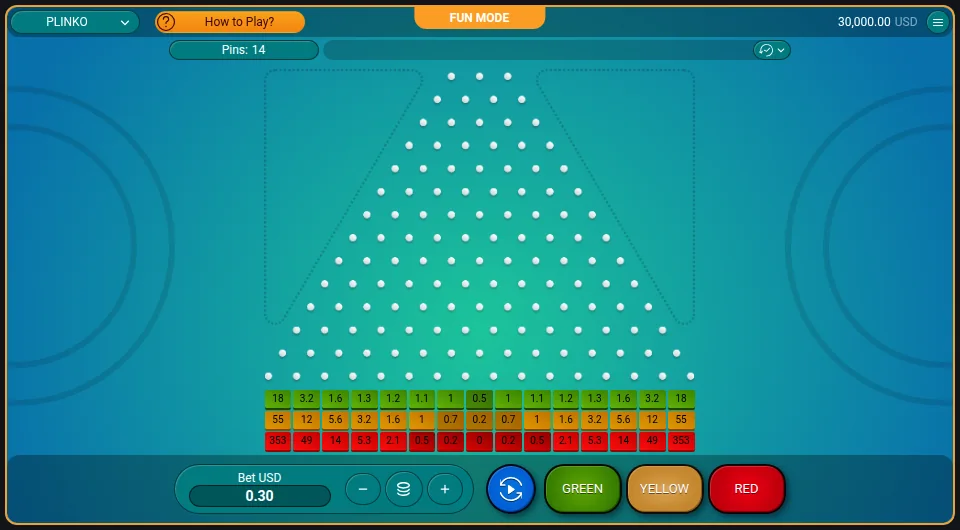
Rows and riskRows decide how many decisions the ball makes on the way down, and therefore how wide the spread of landing places is. Risk decides how sharply the buckets are weighted: at the low setting the middle buckets pay a little more and the edges a lot less, and at the high setting the opposite. Neither control changes how the ball falls. Both change what the landing place is worth. The most complete records in the register.
- More rows widens the fan. The centre stays the likeliest landing place; the extremes become rarer and pay more.
- Higher risk steepens the table. The same landing places, re-priced.
- Every combination has its own paytable, shown in the game before the drop.
What the game does not have
Three things worth knowing in advanceThere is no skill component: the ball is not aimed, and where it enters the field is not a choice. There is no memory: a drop that landed on an edge changes nothing about the next one. And there is no published return figure on this site, for the same reason as everywhere else — the number belongs to that installation and is written in its own rules rather than in a register. Responsible play.
Why the middle is the likeliest place to land
One decision per rowThe ball meets a pin on every row and goes one way or the other. To land on the far left it has to go left on every single row without exception; to land in the middle it has to go left about as often as it goes right, and there are enormously many ways to do that. The edges are rare because only one path reaches each of them, and the centre is common because most paths end there. That is the entire shape of the game, and it is why the paytable rises steeply towards the edges. BitStarz: what is written down.
Adding rows does not move the centre. It lengthens the path, which spreads the landing places wider and makes the extreme ones rarer still — and the paytable for that number of rows is re-cut to match. This is worth saying because the two controls are often described as a difficulty setting, and they are not: nothing about a drop gets easier or harder, because nothing about a drop is being decided by the player at all.
Reading a paytable before the drop
Three things to look at, in order- 01Find the two endsThe largest multiplier sits on the outermost bucket and the smallest in the middle. The gap between them is the whole difference between one risk setting and another, and it is visible before any stake.
- 02Look at the buckets below oneMost combinations price several central buckets under the stake, which is where the commonest outcomes sit. A table advertised on its largest number is being advertised on its rarest one.
- 03Compare the same setting across row countsThe same risk setting is re-priced for every number of rows. Comparing a high-risk eight-row table with a high-risk sixteen-row table is comparing two different paytables, not one setting at two strengths.
None of that is a system and none of it improves a drop. It is simply the one figure in this family that is published in advance, in full, for the exact combination selected — which makes it the only number on the page worth the two minutes it takes to read.
Auto-drop, and the one thing it changes
Rounds per hourA drop takes a couple of seconds and the auto setting removes the pause between them. Nothing about the arithmetic moves; the number of times it is applied per hour does, and with it the amount staked. It is the same observation as the auto play panel on a crash title and it has the same single consequence: the turnover counted towards any bonus requirement accumulates faster, and so does everything else.
Where it sits in this register
In the lobby, not in the scorePlinko is among the in-house titles several of these cashiers describe themselves as holding. As with every other game, that description earns no points: the five blocks of the Cashier Route measure documents, coins and clauses, and a lobby is not a document. The five are set out one by one on the method page, and the records they produce sit in the full register.
Questions people actually ask
What gets typed into a search boxDoes the number of rows change the odds?
Is high risk better than low risk?
Where is the paytable?
Carry on through the register