What the game actually is
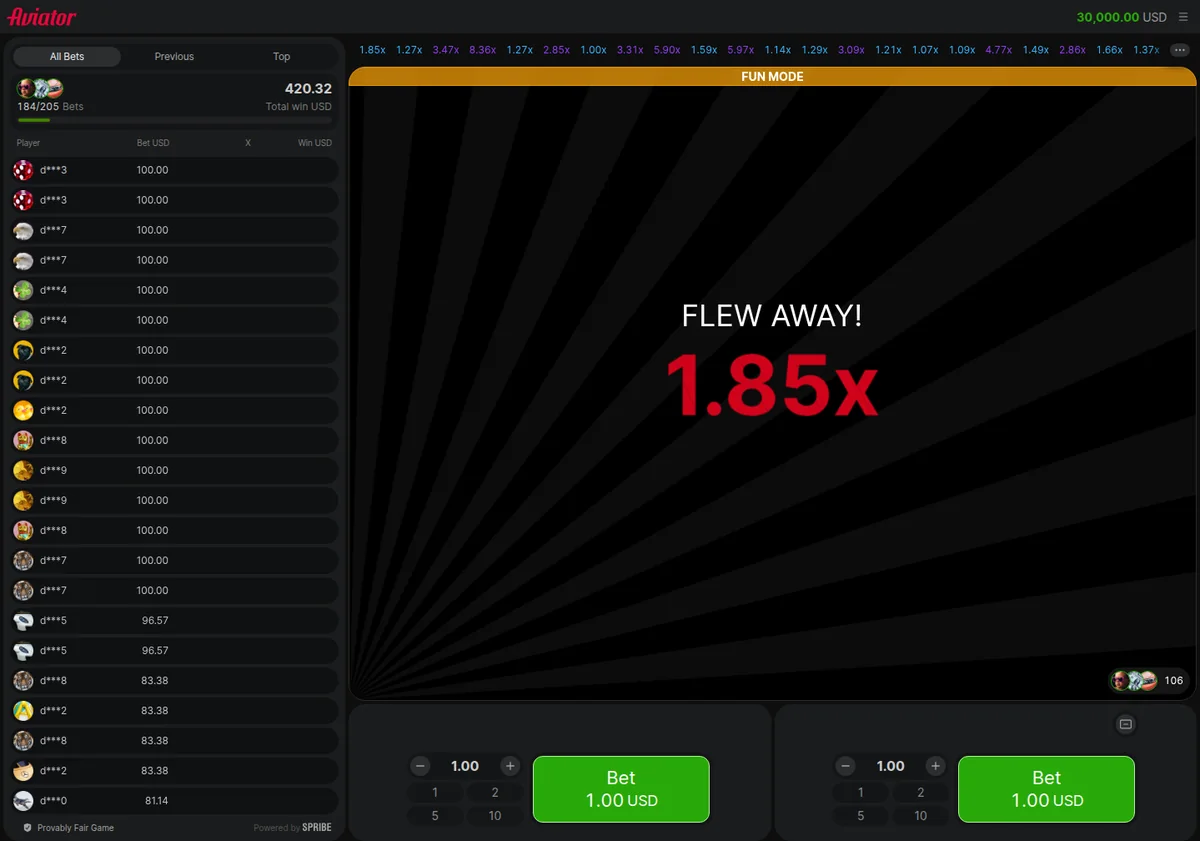
A multiplier and a cash-out buttonA round starts, a multiplier begins at one and rises, and it stops at a point chosen before the round began. A stake placed before the round is multiplied by whatever the number reads when the player cashes out, and lost entirely if the round ends first. That is the whole game. The aeroplane, the rocket and the chicken are interface on top of the same three sentences. The most complete records in the register.
Because the stopping point is fixed before the round starts, nothing that happens during it — watching, waiting, other players' cash-outs on the side panel — changes it. That is worth saying flatly, because most of what is written about this family is about reading a round while it is running. Responsible play.
What a provably fair page proves
And what it does notCrash games usually ship with a fairness page: a server seed committed as a hash before the round, a client seed the player can change, and a published method for combining them into the round's outcome. What that proves is that the result was not chosen after the fact. It is a real property and it is checkable. BitStarz: what is written down.
What it does not prove is the shape of the distribution, which is the thing that actually decides what the game returns over time. That lives in the game's own rules rather than in the fairness page, and it is the same reason this site publishes no return percentage for any game.
The four numbers in a crash round
Only two of them are yoursStripped of the interface, a round has four numbers in it. Two belong to the player and are set before the round: the stake, and the multiplier at which the cash-out happens automatically if it is reached. Two belong to the installation: the point at which the round ends, fixed before it begins, and the ceiling the multiplier cannot pass however long a round runs.
- The stake is bounded by a minimum and a maximum that belong to the table, not to the title, and both are visible before the first round.
- The auto cash-out is the only decision that cannot be made too late. A manual cash-out competes with the round ending; a number entered in advance does not.
- The stopping point was fixed before the round started. Nothing observed while it runs is information about it.
- The ceiling is a maximum win, usually expressed as a multiple of the stake or as a cash amount, and it is the number most often missing from descriptions of this family.
The ceiling is worth finding before staking rather than after. A round that would have run past it pays the ceiling, which means the largest outcomes of the game are not the largest numbers on the screen. Where it is written varies: some titles put it in the rules panel, some in the operator's terms, and some in both with different figures, which is itself worth noticing.
Two panels, auto play, and what they change
Pace, not arithmeticMost crash titles allow two stakes in the same round, each with its own auto cash-out, and most allow a run of rounds to be played without pressing anything. Both are conveniences with the same effect: more rounds per hour and more money through the same fixed arithmetic. Neither changes what a round is worth, and neither is described here as a strategy, because it is not one.
What they do change is how quickly a bonus requirement moves, which is the one place this site's arithmetic touches the games at all. The multiple on the bonus page is a quantity of turnover, and turnover is rounds times stake. How much each round counts towards it is a field none of the twelve records publishes in a form this register could read.
Where the family sits in this register
Inside the cashier, not beside itCrash titles are part of what several cashiers here describe themselves as holding, and that description is the operator's own. Nothing about the games contributes to a record's score: the five blocks measure the licence, the route, the cashier's coins, the verification clause and the bonus arithmetic, and none of those has an opinion about what is in the lobby. Which of the twelve say they hold crash titles is in the description column of the full register, marked as the operator's own words.
Questions people actually ask
What gets typed into a search boxIs there a strategy for Aviator?
What does «provably fair» actually mean?
What is the RTP of a crash game?
Carry on through the register